- Complimentary Shipping & Returns

My Wishlist

Your wishlist is empty
Start saving your favorite items here
Your Cart

Your Shopping Cart is Empty
Looks like you haven't added anything to your cart yet. Let's get shopping!
Start Shopping NowIGI Lab Grown Diamond Grading Report
IGI pioneered the grading of lab grown diamonds in 2005 and continues to lead the field today.
More complex than the analysis of most gemstones, IGI’s lab grown diamond certification process demonstrates unparalleled expertise in the testing and documentation of loose stones and finished jewelry items undergoing lab grown diamond certification. Without disassembling mounted stones or complex pieces, IGI experts perform thorough, objective analysis.
IGI screens every gemstone using state of the art technologies to determine naturally mined, laboratory grown or simulant origin. Experienced graduate gemologists conduct further assessment in controlled conditions, detailing relevant gemological characteristics according to the strictest international system.
Upon request the growth process used and presence of treatments will be noted in the comments section of the IGI lab diamond report.
How To Read A IGI Lab Grown Diamond Grading Report
When purchasing a significant piece of fine jewelry, you are making an investment in a future heirloom. Therefore, it is essential to ensure that the quality of your lab-grown diamond meets your expectations. To confirm that the color, clarity, cut, and carat weight of your lab-grown diamond align with what you are paying for, obtaining a lab-grown diamond grading report is necessary. This independent grading report, commonly referred to as a diamond certificate, serves as third-party verification of your diamond's quality. At Ratneur Jewels, all diamonds weighing 0.50 carats and above come with an IGI grading report, ensuring you can trust the 4Cs of diamond quality. Each IGI grading report can be verified at IGI.org using the report number or the QR code provided on the report.
The International Gemological Institute (IGI) stands as the largest gem grading laboratory globally, with 20 locations worldwide. It issues millions of reports each year for finished jewelry, natural diamonds, lab-grown diamonds, and gemstones. IGI was the first gemological laboratory to receive ISO accreditation for both natural and lab-grown diamond grading. The ISO 17025 certification for laboratory competence is recognized as the most critical standard for calibration and testing laboratories internationally, applicable to all laboratory settings. Additionally, IGI is the first gemological laboratory to pledge carbon neutrality, collaborating with the Responsible Jewelry Council, International Precious Metals Institute, and Initiative for Responsible Mining Assurance, in partnership with SCS Global Services, to reduce its environmental footprint. IGI does not engage in the mining, purchasing, selling, or trading of diamonds, ensuring that its grading remains impartial and objective.
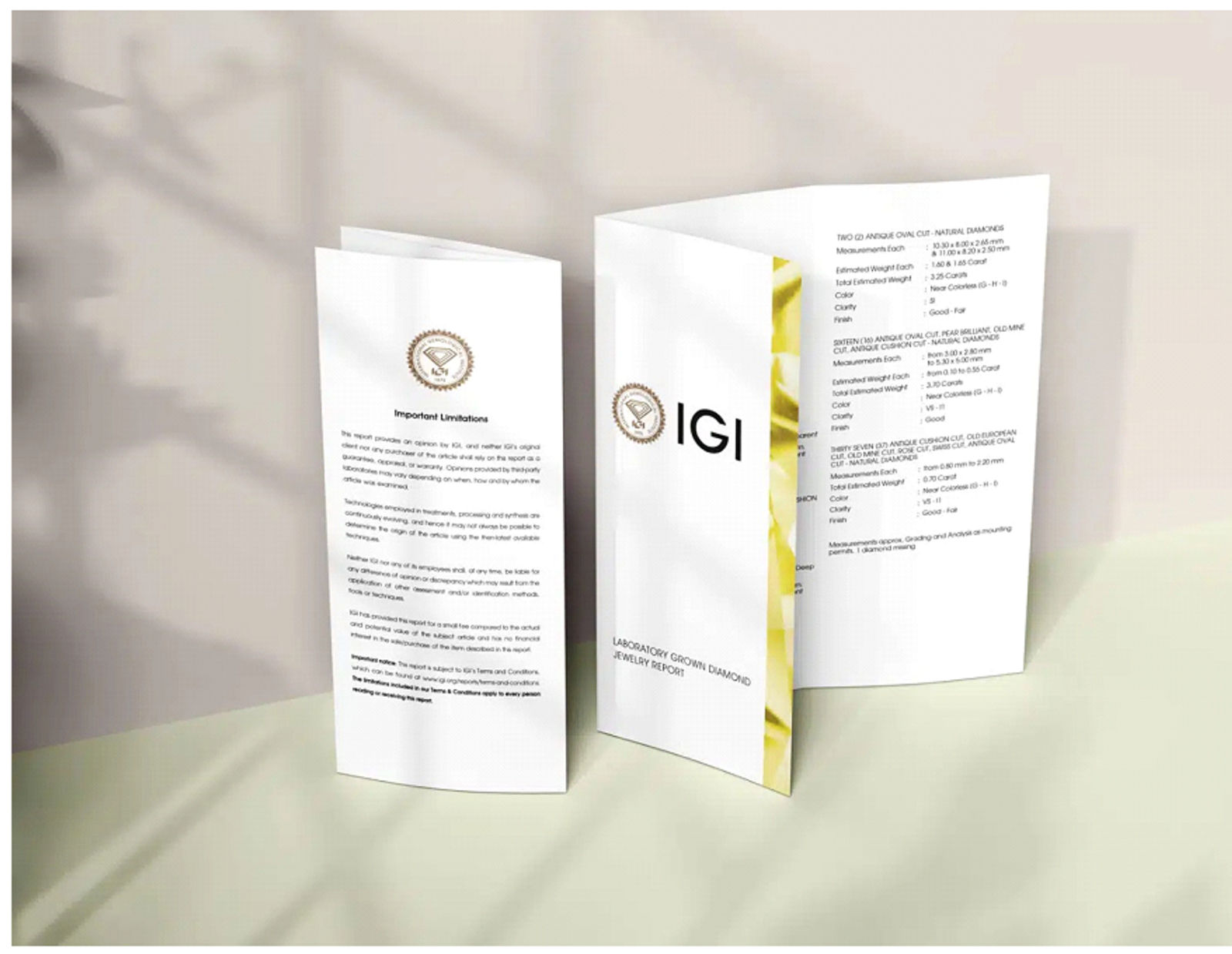
The IGI Lab Grown Diamond Report encompasses a detailed description of the gemstone, including its shape, cutting style, measurements, and an evaluation based on the 4Cs: Carat Weight, Color, Clarity, and Cut. Additionally, diamond reports may feature a graphical representation of the diamond's proportions along with a diagram illustrating its clarity characteristics. The IGI Laboratory Grown Diamond Report maintains the same quality and descriptions as the IGI Diamond Report, with the distinction that the report is presented in yellow rather than white. Furthermore, the girdle of the laboratory grown diamond is laser inscribed with the report number and the phrase 'lab grown.'
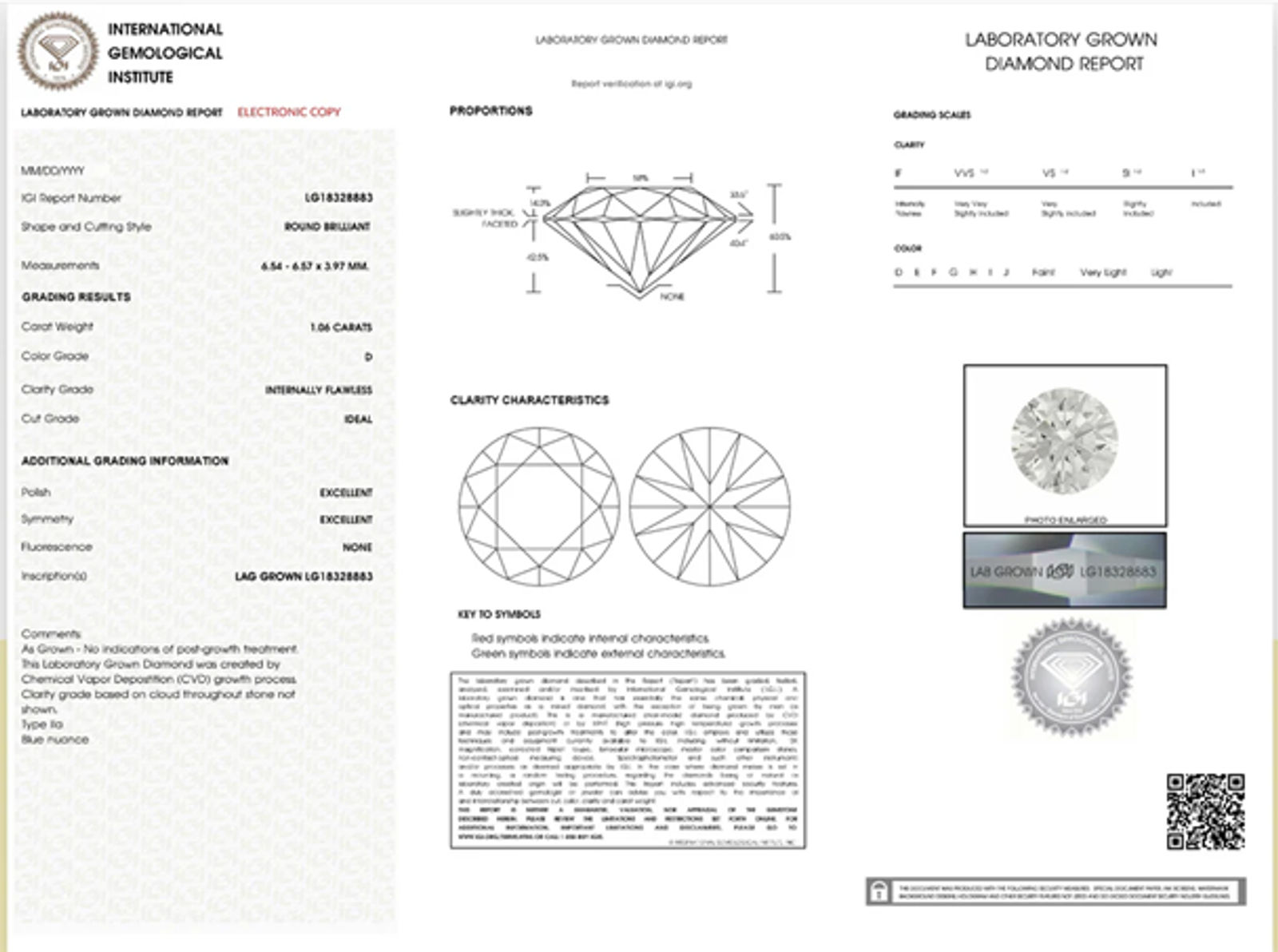
This document outlines the primary sections of the IGI Lab Grown Diamond Grading Report and the contents of each section, serving as a glossary to enhance your understanding of the IGI grading report for your diamond.
Report Number
The unique number can be used to verify the authenticity of the report and confirm the grading details using IGI’s online Verify My Report service. This number is also laser-inscribed on the gemstone’s girdle.
Description
The identity and the origin (in this case, lab-grown) as scientifically determined by IGI.
Shape & Cut
This section describes the outline of the gemstone’s shape and its faceting style. For example, an octagonal diamond could be a radiant cut or an emerald cut.
Measurements
This specifies the gemstone’s dimensions: minimum and maximum width and length, followed by depth. The dimensions are not the same as carat weight. For example, a one-carat round diamond could be 6.2mm or 6.5mm in diameter. Fancy shapes have varying lengths and widths: an oval can be closer to round or more elongated.
Carat Weight
Carat is the standard weight unit for gemstones (not to be confused with karat, which is a measure of gold purity). One carat is 0.20 grams.
Color Grade
Colorless diamond color is graded on a scale from the letter D (colorless) to the letter Z (light yellow, brown or gray). The more colorless a diamond is, the closer to D in the scale, the more expensive it will be. IGI grades diamond color to internationally accepted standards which apply the same way to mined and lab grown diamonds using comparisons to calibrated master stones. All other colors and stronger shades of yellow, brown and gray are classified as fancy colors and are graded on a different scale.
Clarity Grade
Clarity is graded using 10 power magnification assessing the visibility, size, location, color, number and nature of internal and surface characteristics. IGI grades clarity according to international standards that are the same for mined and lab grown diamonds. The clarity scale ranges from flawless (FL) to I3 (obvious large inclusions.)
Cut Grade
Cut of round brilliant is graded on a scale of Ideal to Poor and assesses human craftsmanship factors, including surface polish, faceting symmetry and how the gemstone's overall proportions combine to promote proper physical size appearance and visual beauty components. The better the quality of the cut, the more sparkle and brilliance the gem will have. This cut grade evaluates a diamond's brightness, fire, scintillation, durability, polish, and symmetry. IGI also grades the cut of fancy shaped lab grown diamonds, based on polish, symmetry, proportions and light return. Fancy shape cut grades range from Excellent to Poor. (Ideal is only used for round brilliant diamonds.)
Polish
Polish is a sub-component of the overall cut grade. Graded on a scale of Excellent to Poor, it assesses the smoothness and mirror-like finish of each facet resulting from the diamond polishing process.
Symmetry
Symmetry is a sub-component of the overall cut grade. Graded on a scale of Excellent to Poor, it assesses the shape, uniformity, alignment, and junctions of all the gemstone's facets.
Fluorescence
Fluorescence is a measure of the finished crystal's reaction to ultraviolet (UV) light, expressed in terms of intensity as None to Very Strong. Very Strong fluorescence can sometimes (but not always) make a diamond look hazy.
Inscription
Any microscopic inscription that appears on the gem’s girdle, including the report number and the words “lab grown.”
Proportions
Proportions are measurements of the gemstone's primary and secondary facet groups, largely expressed as average angles and percentages of average girdle diameter.
Clarity Characteristics
A map of the gemstone's internal and external clarity characteristics, as observed at 10X magnification, is provided for purposes of information and identification. The most significant characteristic will be listed first.
Grading Scales
This section shows the grading scales for color, clarity, and cut so you can see where your grades fall in the scales. IGI uses the internationally accepted scales for color and clarity, and its own cut grading standard.
Image
This is a photo of your actual diamond. It’s enlarged and not to scale.
Laserscribe
A photo of the laser inscription on the gemstone's girdle so you can check to see if it matches the actual gem.
Security Seal
Every IGI paper grading report has a tamper evident security seal with enhancements to protect against counterfeiting.
QR Code
This QR code can be scanned to take you to the verified digital version of the report posted on the IGI website.